
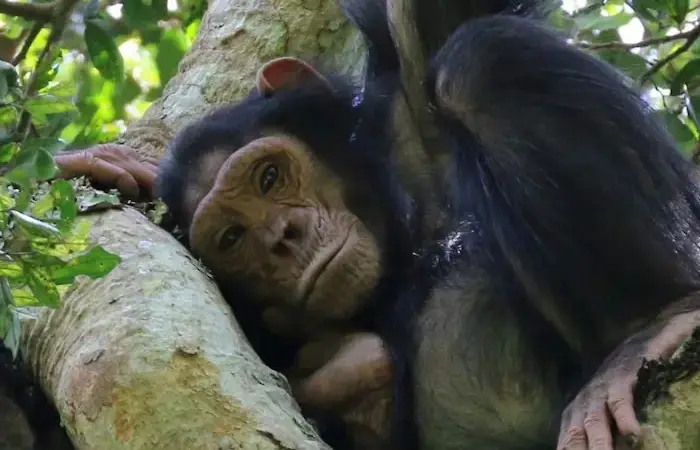
Where Rwanda chimpanzee trekking is done: Chimpanzee tracking in Rwanda is mainly conducted in Nyungwe Forest National Park, which is well established with higher success rates. Gishwati Mukura National Park is also an upcoming destination to track the primates. For a complete primate safari in Rwanda, chimpanzee tracking can be combined with golden monkey and gorilla trekking in Volcanoes National Park.
Nyungwe Forest National Park, covering over 1,000 sq. km, is one of Africa’s oldest Afromontane forests with rich biodiversity, including over 500 chimpanzees; 13 primate species, including the Rwenzori colobus monkey; and over 300 bird species, of which 17 are Albertine Rift endemics. Nyungwe is managed by the African Parks Network in partnership with the Rwanda Development Board; they have established world-class experiences, including a canopy walk, birding, and over 13 hiking trails.
Habituated chimpanzees in Nyungwe are tracked in three locations, which include Cyamudongo Forest, Uwinka Visitor Center, and Gisakura. An official briefing on the rules and regulations takes place early in the morning, followed by a transfer to the presumed tracking point. Given that chimpanzees are very active and unpredictable, trackers and rangers rely on GPS to coordinate. As a result, hiking on foot in the dense tropical forest can be challenging. Chimpanzee tracking in Rwanda may last for 1 to 6 hours, depending on the movement of the primates.
Cyamudongo Forest
Cyamudongo Forest, a 19 sq. km forest, has a well-habituated chimpanzee community, which may be easier to locate due to the relatively smaller area. The forest was detached from the main Nyungwe forest due to deforestation. It remains isolated and surrounded by agricultural farms but is part of the main protected area.
Uwinka sector
Located within the central part of Nyungwe Forest National Park, the Uwinka visitor center serves as the park headquarters and main briefing point for chimpanzee tracking and the canopy walkway. The chimpanzee troop in the Uwinka sector has over 50 individuals and roams over a relatively large home range. Tracking them can be challenging depending on their movement; however, the encounter is very fascinating due to the size of the troop.
Gisakura sector
The chimpanzee community in the Gisakura sector, the western part of Nyungwe Forest, is still undergoing habituation, and tracking offers an opportunity to spend more than 1 hour with the primates, making for an in-depth experience. Every chimpanzee trek is led by experienced RDB rangers, guides, and trackers. Whether you’re allocated to a track from Uwinka, Gisakura, or Cyamudongo Forest, there’s a high chance of seeing the chimps. Once the primates are located, visitors are permitted to spend 1 hour observing them in their natural habitat.
Gishwati Mukura National Park
Rwanda’s emerging chimpanzee tracking destination, Gishwati Mukura, was established in 2015 by gazetting and merging two fragmented forests through the creation of buffer zones. The protected area covers 35 sq. km, ranging from 2,000 to 3,000 meters in the Rutsiro and Ngororero districts, Western Province. Endangered species, including chimpanzees, golden monkeys, and over 126 Albertine rift endemic bird species, inhabit the park. The park was opened for tourism after the COVID-19 pandemic, with activities focused on reforestation, community-based tourism, and conservation, where you will gain insights into Rwanda’s biodiversity restoration initiatives.
Guided primate tracking is one of the long-term ecotourism activities. Visitors may encounter chimpanzees during guided nature walks, however. Sightings are relatively unpredictable due to ongoing habituation; the experience is still authentic and wild. Guided nature walks also offer an opportunity to spot golden monkeys and L’Hoest’s monkeys. In addition to primate walks, Gishwati-Mukura National Park offers a wide range of community-tourism-based activities, including rural farm and dairy traditions, visiting a herbalist for his stunning metaphysics, local crafts, and beekeeping and tea plantation tours.
Best time to TREK THE chimpanzees in Rwanda
Chimpanzee tracking can be done any time of the year; however, the best times are the dry seasons between June and September and December and February. The trails are relatively drier, which can make hiking on foot easy. During the dry season, the primates tend to be highly active in search of fresh foliage, so while it is the best time, the trekking can be challenging due to the chimps’ movement. Chimps can also be tracked during the wet season, the short rains of October and November, and the long rains of April to May.
The high amount of rainfall received, ranging from 800mm to 1500mm per annum, means that the tropical forest trails can be wet and slippery. However, rain also makes for less foliage; the chimps tend to feed near the park edges or may not move for so long, making for relatively shorter treks. Temperatures tend to remain almost the same across Rwanda, with an average range between 19°C (66°F) and 11°C (52°F) at night, making for pleasant weather to travel.
How long does chimpanzee tracking take?
Chimpanzee trekking may take 1 to 6 hours, depending on the movement of the primates. The activity can be challenging due to the nature of the terrain.
Cost of chimpanzee trekking permits in Rwanda
The Nyungwe chimp permit cost is $150 per person for foreign non-residents, $75 for foreign residents, and $25 for Rwandan citizens. To track chimps, one must have a permit, which is available for booking through the Rwandan Development Board online portal or head offices in Kigali and/or through a registered tour operator. The permits should be booked 2-3 months ahead for those planning to track in the dry season due to high demand.